Monday, 4 February 2013

Kinetic Particle Theory Intro 4/2/13

Introduction: 

Overview Mind Map
Questions to ask for assumptions and limitations for particle model


Saturday, 2 February 2013

Are you good enough for it? 2/2/13

Group Activity- Are you good enough for it ?

Question : How do you separate mixture of  iron filings , iodine ( sublime when heated) , copper Sulfate (ll) , Calcium Sulfate , Ammonium chloride ( sublimes when heated ) and Lead (ll) bromide

suggested answer from mr foo's slides:


Element, Compound & Mixture 

(Answer Techniques)
Nitrogen Atoms

Element:

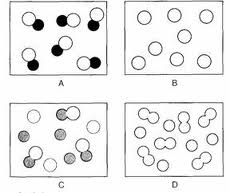
  • This diagram shows a element
  • REASON: (type of element) atoms combined to form diatomic molecules.


Mixture: 


Mixture of elements:
____ and ___ are not chemically combined

Mixture of molecules:
two elements are in the form of diatomic molecules but are not  chemically combined with one another

Mixture of 2 different compounds made up of the same elements:
same constituent elements in different ratio.

Mixture of 2 different compounds :
two different compounds that are not chemically combined with one another

Compound:


( pure) compound:
two different types of element chemically joined together in a fixed ratio.

*pure compound: A pure compound is a substance composed of a specific molecule or formula unit composed of 2 or more elements that cannot be broken down physically.


Separation Technique Assignment 1 for test !

Tuesday, 29 January 2013

Crystallisation, Separating Funner & Sublimation 29/1/13

Crystallisation - Lab Experiment


Lab worksheets

Separating Funnel

Simple Diagram of Concept behind Separating funnel


Example: Oil and Water.
--> Separate Immiscible Liquids

Sublimation


Simple Examples

Crystallization 28/1/13

Crystallization ( refer to slides handout given)

Different from Distillation:
End Product:
Distillation --> solution
Crystallization --> Solute

  • Sodium Chloride ( normal salt solution )  -> CANNOT  ->  same solubility over different temperature.
You need a saturated solution to carry out crystallization.
different from concentrated solution
  • contains the maximum amount of solute dissolved in a given volume of solvent at a particular temperature
  • A concentrated solution: A solution that contains lots of solute dissolved in it.

Speed of Crystallisation And The Size of Crystals Obtained

  • Rapid cooling of saturated solution
        - small and ill-shaped crystals formed
  • Slow evaporation of a cold saturated solution
        - large and well-defined crystals obtained.

graph showing Concentration vs Temperature during Crystallisation


Friday, 25 January 2013

Lab Experiment - Separation Techniques 26/1/13

Chromatography- Food Colouring Experiment ( Individual Work)

Experiment Process: 

Learning Points:

  • Locating Agents can be used to convert colourless chemicals into coloured, such that it is possible to separate a mixture of colourless chemicals by chromatography
  • Factors affecting the Rf of a chemical:
            - Temperature: When temperature is higher, the dye is more soluble, hence it will travel higher up.
           - Paper: When the paper changes, it may absorb the dye better, hence the rf value is lowered.
           - solvent : type of solvent will affect the distance travelled by the dye, rf value higher/lower ( depending on the the amount of chemicals it dissolves

  • Uses of Rf value:
           - Identify the individual components in dye
           - estimate/ predict the element.

Chromatography as a SYSTEM:

All the components must be present in order for the chromatography to work. It is made up of different parts with different functions to serve one common purpose -> identify and separate the mixture.

Principle: More Soluble -> travel farther than less soluble
       --> difference in solubility ; enables separation

Chromatography almost done! 


Thursday, 24 January 2013

Separation Techniques 24/1/13

Pre-lab Questions on Distillation:

  • What is the purpose of the boiling stones/chips?       

A boiling chip or boiling stone is a tiny, uneven shaped piece of substance added to liquids to make them boil more calmly. Boiling chips are frequently employed in distillation and heating. When a liquid becomes superheated, a particle of dust or a stirring rod can cause flash boiling. This very rapid boiling can be extremely violent and cause reagents to splatter, possibly causing severe burns, ruining an experiment, and damaging equipment. Boiling chips work by providing nucleation sites so the liquid boils smoothly without becoming superheated or bumping

  • What is smooth boiling?
( refer to answer above ^)
  1. What is the purpose of the thermometer and condenser?
condenser: to convert the gas form of a substance into a liquid. If the temperature and boiling points are kept constant, then the substance with the lower boiling point will be able to be evaporated and condensed, thus separated. The condenser ultimately just cools the gas form of the substance so it may return to the liquid state.

Thermometer: The thermometer on top measures the temperature of the vapor right before it condenses (boiling point).
  1. Why does the water comes in from the top and out from the botton? (main purpose and purpose of position)
If water enters from the bottom of the condenser, it will always be completely filled with cold water which ensures efficient cooling. During distillation, vapors are formed in the heated distillation flask. The condenser cools these vapors condensing them back to liquid droplets that flow down the condenser into the receiver flask. A completely filled condenser provides maximum cooling therefore allowing for maximum recovery of the purified liquid during distillation.

Is it due to the concept of hot air rises and cold air sinks? ( Not Sure)

Theory Lesson:

Separation Techniques: mainly on Chromatography & Simple and Fractional Distillation
refer to slides on 'Separation Techniques Introduction'


references: - --http://www.chem.ualberta.ca/~orglabs/Techniques%20Extra%20Info/Distillation.html#same  - wikipedia

Monday, 21 January 2013

Mixture & Compound.Alloy.Separation Techniques 1 21/1/13

Revision: Element, Compound & Mixture

Example of a mixture of elements
Example of a mixture of compounds


Alloy:

  • MIXTURE
  • Mixture of metals with other elements
  • Stronger. Not malleable
* STEEL
   STAINLESS STEEL
   BRONZE
   COPPER   MUST KNOW-S!


Separation Techniques
  • Used only for Mixture
  • Physical Means
  1.          Magnetic Attraction
  2.          Filtration
  3.          Use of separatin funnel
  4.          Distillation
  5.          Crystallization
  6.          Evaporation
  7.          Sublimation
Method used depends on element's properties. e.g. soluble/insoluble

Mixture needs to be separated into pure substance for...
  • Characterization (identify properties)
  • Identification ^
  • Production of useful substances such as medicine


Paper Chromatography

  • separate a mixture of solutes with different solubility and degree of absorption
  • The method uses a solvent moving over a porous or absorbent medium
Solvent : Water / ethanol

Principle ( Uncompleted)
  • As solvent travels up the paper, the dyes dissolved
  • some dyes are more soluble, so they travel faster up the paper
  • dyes that are less soluble remain as the bottom of the paper (own comment)
example of a paper chromatography experiment