Thursday, 28 March 2013

Chemical Changes

Chemical Change:


  • process that produces new substance (s)
  • Particles of substance are broken apart
  • Atoms are rearranged into new particles, forming a new substance

Types of Chemical Changes/ Reaction:

  • Combination -> 2 or more elements combine to form a new product compound involving energy change
  • Combustion-> a substance burns in oxygen to produce new product (s)
  • Thermal (heat) Decomposition-> A compound breaks down into 2 or more smaller substances
  • Precipitation -> 2 aqueous solutions are mixed to form one solid product (precipitate)
  • Photosynthesis
  • Respiration
How to define if its  a chemical/ physical change

INFORMATION ON WORD EQUEATION:


Burning 
This is when a substance reacts with oxygen and produces a flame.
Burning always produces an OXIDE.
Burning an element produces ONE oxide.
Burning a compound produces TWO or more oxides.
The mass of the oxides formed will always be MORE than the mass of the substance being burned. (why?)
eg i. Burning magnesium
Burns with bright white flame to form magnesium oxide
Word equation: Magnesium + oxygen ----> magnesium oxide
Burning Methane (natural gas)
Methane is a COMPOUND of carbon and hydrogen. (ie a hydrocarbon. other hydrocarbons are wax, petrol)
It burns with a smoky flame to form carbon dioxide and water
Word equation: Methane + oxygen ------> carbon dioxide and water
Alcohol will also burn to form carbon dioxide and water.
This is when a compound splits apart and forms two (or more) new substances.. (Each of the new substances contains atoms that was there to start with)
note : Elements can NEVER decompose because they are only contain ONE kind of atom.
Each new substance formed will have LESS mass than the original substance
eg i. Heating copper sulphate
Copper sulphate DECOMPOSES and forms water vapour, leaving white anhydrous copper sulphate.
Word equation: Hydrated copper sulphate ----> anhydrous copper sulphate + water
NOTE: This reaction is reversible. If water is added to anhydrous copper sulphate then the solution turns blue again accompanied by a rise in temperature.
Heating copper carbonate The copper carbonate DECOMPOSES forming carbon dioxide gas and leaving copper oxide. 
Word equation: Copper carbonate ----> copper oxide + carbon dioxide
iii. Heating limestone
The limestone decomposes and forms LIME and carbon dioxide gas
Word equation: Calcium carbonate -----> calcium oxide + carbon dioxide
or Limestone -----> lime + carbon dioxide

Reactions in Biology
 i Respiration 
Respiration is the reaction that takes place in ALL living organisms that releases energy from sugar. This energy is used by the organisms for essentials like growth, movement and warmth
Word equation: Glucose + oxygen ----> carbon dioxide + water
ii Photosynthesis
This is the reaction that takes place in the chloroplasts (found mainly in leaves) of plant cells
It converts carbon dioxide and water into sugar and starch, using energy from the sun.
Word equation    Carbon dioxide + water -----------> glucose + oxygen 
(Chlorophyll+ sunlight)


Precipitation 
e.g. lead (ll) nitrate + potassium iodide -> potassium nitrate + lead (II) iodide

Combination :
e.g. Potassium + chlorine gas -> Potassium chloride


JUST FOR LAUGHS :D

Physical Phenomena

Types of Physical Phenomena:


Heat gained: 

  • Melting
  • Boiling
  • Evaporation
  • Sublimation
Heat loss:
  • Freezing
  • Condensation
  • Deposition
Others:
  • Dissolving
  • Diffusion

Physical Phenomena can be explained through Kinetic Particle Theory:

Example of heat gained ( Melting ):
Particles in solid only vibrate in fixed positions due to strong forces of attraction holding them closely together.
Upon heating, heat energy is absorbed by the particles of the liquid. The heat energy is converted into kinetic energy. The particles move faster as the temperature rises. When the temperature is high enough to reach melting point of water, the heat energy taken in is used to overcome the forces of attraction holding the particles together.
After melting is completed, heat energy is taken in to increase the kinetic of the particles, which now slides past each other continuously at a higher average speed.

Example of heat loss (Desublimation):
Particles in gas state move far apart from each other in a random direction and constant motion.
Upon cooling, heat energy is loss and the particles lose kinetic energy. The particles move slower as the temperature decreases. When the temperature os low enough to reach the desublimation point, the attractive forces of the particles strengthen as the particles does not have sufficient energy to overcome the forces.
After desublimation is completed, heat energy loss decreases the kinetic energy of the particles which vibrate in fixed positions in constant motion at a slower average speed due to strong attractive forces holding them close together.

Diffusion:
      Diffusion of a substance eg. a drop of ink in a glass of water; is evidence of matter being made up of tiny particles in constant random motion.
    When a drop of ink is added to a glass of water, it is observed that the ink spreads to different parts of the water without the need to stir.
   If particles are not already moving constantly, the ink would not be observed to spread on its own.
    There is no fixed pattern or direction to the movement/spread of the ink, indicating that the movement is random.


Assumptions and Limitations.

However, there are Limitations and Assumptions are made when using KPT model to explain the physical phenomena.


Assumptions:
(refer to handout given)
Limitations
(refer to handout given)


Friday, 8 February 2013

Theory- Kinetic Particle Theory 8/2/13

Kinetic Particle Theory

Explained by:
  • diffusion
  • inter conversion of states
  • Brownian Motion
Represented through:
  • kinetic particles model
          -> explains particles' motion and arrangement in 3 states of matter

Example of particle motion

Physical Properties!! ( things that CAN be measure )

  1. Volume
  2. Mass
  3. Density
  4. Conductivity
x SHAPE    
x SIZE 

Mini Quizzz:

Use KPT to explain what happens to the particles
  1. When an ice cubes melts
  2. When water boils
When heat is supplied, water molecules gain energy and vibrate faster about their fixed position
When solid water molecules gain sufficient energy to overcome the hydrogen bonding that hed them in fixed positions,
the water molecules will move slightly apart and now roll and glide over each other (LIQUID)

Water  molecules gain energy, they move faster and further apart
When water molecules gain sufficient energy to completely overcome the hydrogen bonding between the molecules,
the water molecules move far apart and away from each other . (GAS)

melting point/ boiling point --> shows that heat is about to break up the bonding
* bond between water molecules = hydrogen bond 

Condensation
  • loses heat to the surrounding
  - forms bonds

* think about freezing , condensation and sublimation

3 states of matter at different temperatures:


Thursday, 7 February 2013

Kinetic Particle Theory 7/2/13


Investigating Diffusion in Matter


3 main points of experiment:

  • spaces between particles
  • Particle molecules in constant, random motion 
  • Substance with greater mass ( heavier ) moves much slower --> slower diffusion rate.

forces of attraction between particles
solid > liquid > gas

energy of particles:
solid < liquid < gas

e.g. : With greater energy, gas is able to overcome the forces of attraction between particles and thus move freely.

KPT limitation:
--> electrical conductivity ( does not explain)

Assumptions:
-> particles have kinetic energy
-> particles are in constant, random motion
-> forces of attraction between particles.


Monday, 4 February 2013

Kinetic Particle Theory Intro 4/2/13

Introduction: 

Overview Mind Map
Questions to ask for assumptions and limitations for particle model


Saturday, 2 February 2013

Are you good enough for it? 2/2/13

Group Activity- Are you good enough for it ?

Question : How do you separate mixture of  iron filings , iodine ( sublime when heated) , copper Sulfate (ll) , Calcium Sulfate , Ammonium chloride ( sublimes when heated ) and Lead (ll) bromide

suggested answer from mr foo's slides:


Element, Compound & Mixture 

(Answer Techniques)
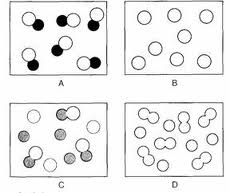
Nitrogen Atoms

Element:

  • This diagram shows a element
  • REASON: (type of element) atoms combined to form diatomic molecules.


Mixture


Mixture of elements:
____ and ___ are not chemically combined

Mixture of molecules:
two elements are in the form of diatomic molecules but are not  chemically combined with one another

Mixture of 2 different compounds made up of the same elements:
same constituent elements in different ratio.

Mixture of 2 different compounds :
two different compounds that are not chemically combined with one another

Compound:


( pure) compound:
two different types of element chemically joined together in a fixed ratio.

*pure compound: A pure compound is a substance composed of a specific molecule or formula unit composed of 2 or more elements that cannot be broken down physically.


Separation Technique Assignment 1 for test !

Tuesday, 29 January 2013

Crystallisation, Separating Funner & Sublimation 29/1/13

Crystallisation - Lab Experiment


Lab worksheets

Separating Funnel

Simple Diagram of Concept behind Separating funnel


Example: Oil and Water.
--> Separate Immiscible Liquids

Sublimation


Simple Examples